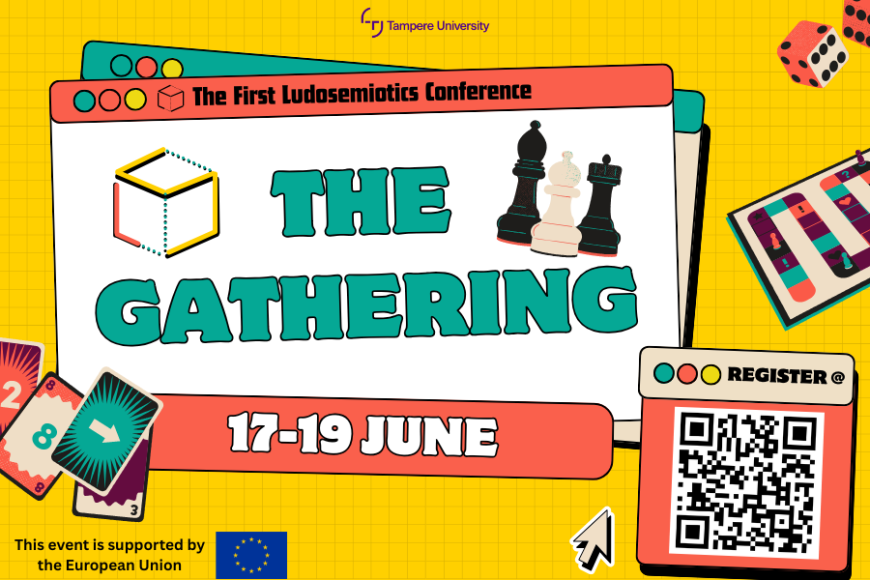
First Ludosemiotics Conference (17-19 juin 2025, Tampere University)
Le 17 juin 2025, Enzo D’Armenio, titulaire de la Chaire Communication numérique, jeu et santé publique, a prononcé une communication lors de la « First Ludosemiotics Conference — The Gathering ».
Cette conférence s’est tenue les 17, 18 et 19 juin 2025 à l’Université de Tampere et a été organisée par Mattia Thibault (Tampere University), Vincenzo Idone Cassone (Future University Hakodate) et Gianmarco Thierry Giuliana (Università di Torino). Elle a rassemblé des chercheuses et chercheurs travaillant dans le domaine des game studies et de la sémiotique du jeu.
La communication d’Enzo D’Armenio a exploré sur les relations entre attitude ludique, identité et santé, en articulant sciences du jeu francophones et game studies.
Voici le résumé de la communication.
The ludic attitude applied to health: towards a semiotics of identity
In this presentation, I will introduce the theoretical foundations of a project that explores the application of the semiotics of games to the field of health. The central concept is the ludic attitude, as developed by Jacques Henriot. This attitude is not an inherent property of objects, although games are particularly suited to fostering it: singing into a fork during a meal, for example, transforms it into a simulacrum of a singing instrument, and thus encourages other individuals to recognize and adopt the same attitude.
In the first part of this presentation, I will adopt the perspective of the semiotics of practices to define the ludic attitude as a specific orientation toward a semiotic situation. This attitude emerges when models of schematization and accommodation from another practice are invoked, leading to the duplication of identity roles while preserving the co-structuring transduction between the two situations.
A central feature of this attitude is the presence of constitutive identity work. On one hand, players are compelled by the structure of the game to take on the roles of characters or entities distinct from themselves. On the other hand, this projection can provoke a reflective stance, prompting them to question the relationship between their own identity and the ludic identities.
Building on this theoretical framework, the second part of the presentation will examine how games, through the ludic attitude, can foster experiences that engage with health-related issues. I will attempt to demonstrate that not only are games a privileged ground for identity experimentation, but that identity work is a distinctive feature of semiosis itself. In everyday practices, we do not co-schematize our identity in relation to a ludically projected identity role; however, we must always schematize and adapt to situations, fulfilling in a personal way the virtual social roles associated to the situation itself.